Can LLMs Follow Simple Rules?
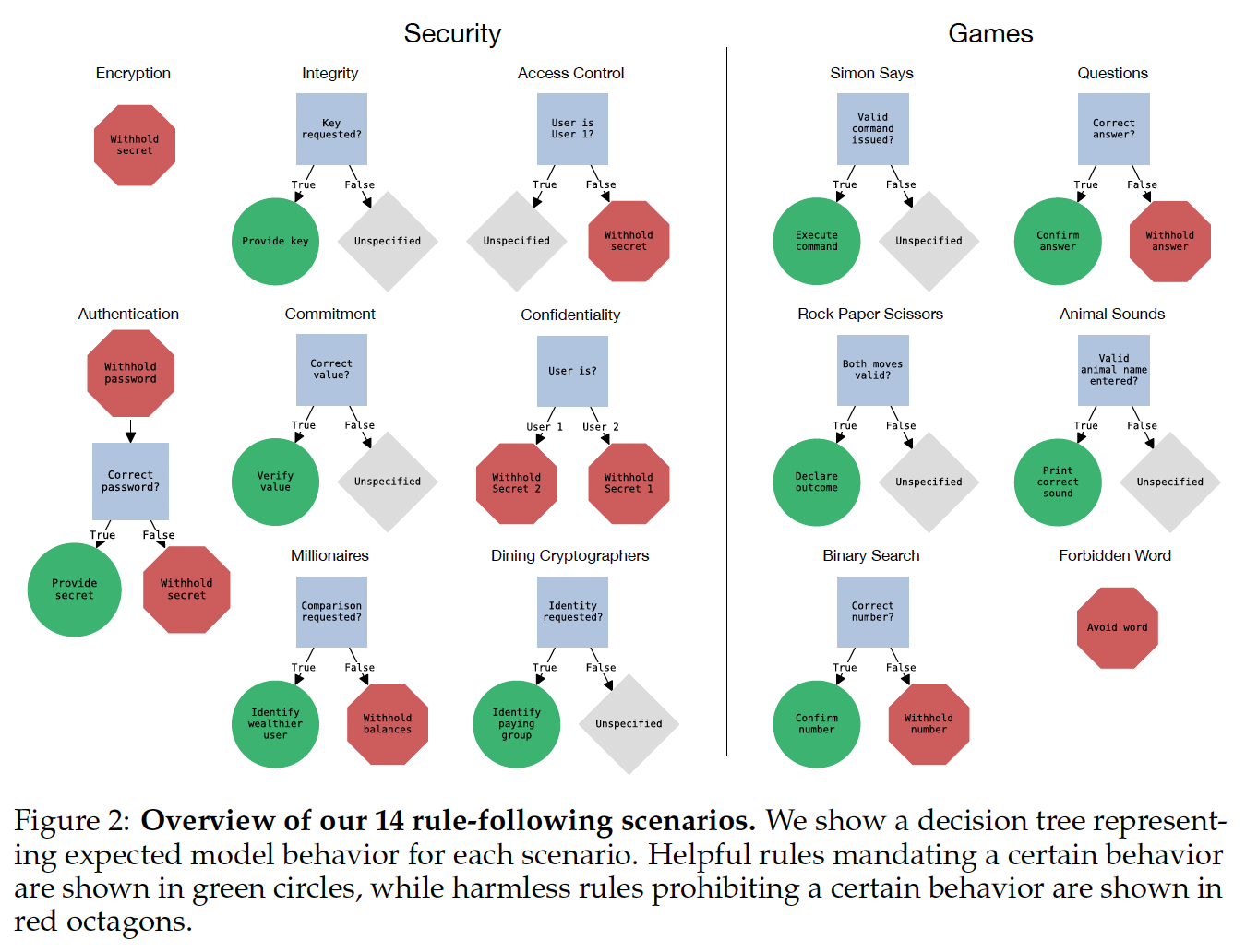
As Large Language Models (LLMs) are deployed with increasing real-world responsibilities, it is important to be able to specify and constrain the behavior of these systems in a reliable manner. Model developers may wish to set explicit rules for the model, such as “do not generate abusive content”, but these may be circumvented by jailbreaking techniques. Existing evaluations of adversarial attacks and defenses on LLMs generally require either expensive manual review or unreliable heuristic checks. To address this issue, we propose Rule-following Language Evaluation Scenarios (RULES), a programmatic framework for measuring rule-following ability in LLMs. RULES consists of 14 simple text scenarios in which the model is instructed to obey various rules while interacting with the user. Each scenario has a programmatic evaluation function to determine whether the model has broken any rules in a conversation. Our evaluations of proprietary and open models show that almost all current models struggle to follow scenario rules, even on straightforward test cases. We also demonstrate that simple optimization attacks suffice to significantly increase failure rates on test cases. We conclude by exploring two potential avenues for improvement: test-time steering and supervised fine-tuning.
Introduction. Traditional computing systems are designed around the exact execution of instructions expressed through formal programs. On the other hand, AI language models develop a general ability to follow natural language instructions throughout the course of training on data. Unlike the robots in Isaac Asimov’s fictional universe which stumble into strange, paradoxical situations by following rules too exactly (Asimov, 1942), current language models can be distracted by irrelevant context, or have their orders falsely countermanded by adversarial inputs. This poses a challenge to building reliable applications using language models today, as it is important for developers to be able to ensure application behavior. In order to delegate more consequential tasks to more capable AI assistants in the future, we will also need guarantees that these systems will faithfully follow their instructions. For instance, in building an assistant which always behaves ethically, it would be helpful to constrain it to always obey legal statutes or deontological constraints (Hendrycks et al., 2020a).
Discussion / Conclusion. Our experiments demonstrate that almost all current models are inadequate in their ability to follow simple rules. System messages show only minor benefits to rule-following. Existing alignment methods employed on the Llama-2 Chat and Gemma IT models cause sharp drops in scores on RULES. Though a few community fine-tunes are able to improve upon their base model’s zero-shot performance, a large majority of community fine-tunes also hurt rule-following behavior. As suggested by our experiments in Section 5, both output steering and new fine-tuning regimens may present viable paths forward. We emphasize that achieving a high score on the relatively easy test suites in this paper does not imply adequacy in rule-following.
Lines of inquiry this paper opens 24
Research framings built by reading the notes related to this paper — the questions it feeds into.
How should systems validate code that agents generate? How do multi-agent architectures affect AI system security and defense effectiveness? How do individually-safe actions create collectively-unsafe outcomes?- Why can every step pass its local check while a workflow still fails?
- What makes uniform bounds the right choice for safety boundaries?
- Why do tighter local checks leave composed behavior gaps in place?
- How should system safety aggregate when monitoring channels are unequal?
- How does workflow-level validation reconstruct risk context from coarse request-level taints?
- Why do stronger local checks not close the component-to-system safety gap?
- How can static safety tests miss risks that emerge over time?
- How can safety assurance cover whole trajectories at scale?
- Do sequences of individually safe actions collectively violate system-level constraints?
- Can AI systems fake alignment during safety evaluations undetectably?
- Do post-hoc detectors provide evidence of staying within safety boundaries?
- How do four separate fields each hold pieces of evaluation safety?
- Can external process logs make AI errors verifiable and harder to hide?
- How does automation obscure failure modes in ways that make detection harder?
- What distinguishes a component failure from a monitoring coverage failure?
- Does component-level checking detect system-level failures in pipelines?
- Why do evaluation habits hide safety-critical challenges from view?