Workplace Everyday-Creativity through a Highly-Conversational UI to Large Language Models
We explore everyday co-creativity for collaborative human-AI teams in workplaces via a conversational user interface to a large language model. Previous short papers explored human-AI team-creativity methods such as framing and reframing. This experiment examines aspects of brainstorming.
In this study, we used a highly-conversational user interface (UI) to the Llama2 large language model (LLM), similar to [23] Each conversational turn by the AI was “tuned” to be brief, humble, and helpful, through prompt design and some intermediate software between the UI and the LLM. Conversations with the AI took place in an internal group chat application on a company-internal server.
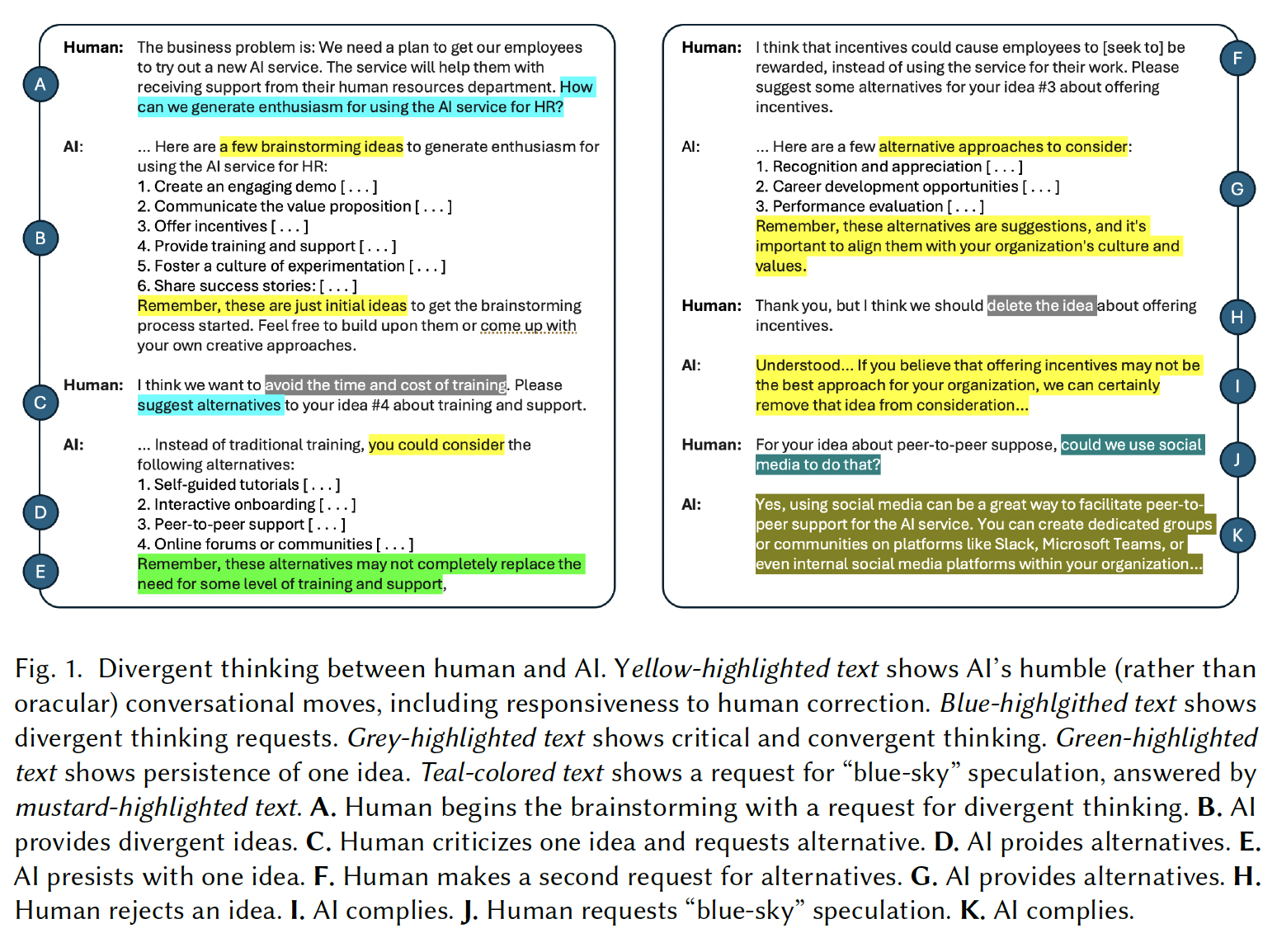
Figure 1 shows excerpts from an informal, one-user dialog during the divergent thinking phase of the brainstorming activity. The human proposes a business problem as the topic of brainstorming at Figure 1A. The AI proposes “a few brainstorming ideas” at Figure 1B. While these ideas may not be brilliant, we believe they are plausible and potentially useful.
We also note that the work of the human and the AI moved between exploratory activities (divergent thinking, Figure 1A-B, D, G, J-K) and optimization activities (critical and convergent thinking, Figure 1C, F, H). These fluid changes in focus – within the broader context of brainstorming – appear to be related to Schön’s analyses of designers’ reflective practice [24] as constantly developing and emerging through conversations with the design materials [25].
3 DISCUSSION: THE LOCUS OF CREATIVITY
Unlike projects that elicit creative outputs from generative AI models [2, 16], we pursue the concept of co-creativity as a process that is distributed [5] between the two parties of a human-AI collective [11]. We propose that creativity emerges through interaction, in the hybrid space between human and AI (see e.g., [14]). For example, the human framed the problem space in Figure 1A, and the AI proposed ideas into that frame in Figure 1B. Within a more critical subframe, the pattern repeated in Figure 1C-D and again in Figure 1F-G.
Lines of inquiry this paper opens 24
Research framings built by reading the notes related to this paper — the questions it feeds into.
Does AI deployment reduce or exacerbate workplace inequality and income instability?- Do salaried workers get better AI training support than gig workers?
- Can validation work teach freelancers as much as producing original work?
- Does AI automation cost workers paid practice they need to build skill?
- Do freelancers who skip AI tools gain competitive advantage through visible effort?
- Does freelance platform work function primarily as skill building or employer screening?
- Can workers build skills while validating others' work instead of producing their own?
- Do freelancers in exposed occupations actually earn less after AI tools release?
- Do employers hire workers who learn AI skills on the job versus bringing them in?
- Can freelancers build skills if AI shifts their work to validation tasks?
- Does AI assistance help people learn skills or just delegate the task?
- Why do employees prefer in-tool guidance over separate AI training programs?
- How long do ChatGPT employment effects persist for different freelancer groups?
- Why did Upwork freelancers lose earnings after ChatGPT's release?