Virtual Assistance in Any Context
Abstract Several domain-specific assistants in the form of chatbots have conquered many commercial and private areas. However, there is still a limited level of systematic knowledge of the distinctive characteristics of design elements for chatbots to facilitate development, adoption, implementation, and further research. To close this gap, the paper outlines a taxonomy of design elements for chatbots with 17 dimensions organized into the perspectives intelligence, interaction and context. The conceptually grounded design elements of the taxonomy are used to analyze 103 chatbots from 23 different application domains. Through a clustering-based approach, five chatbot archetypes that currently exist for domain-specific chatbots are identified. The developed taxonomy provides a structure to differentiate and categorize domain-specific chatbots according to archetypal qualities that guide practitioners when taking design decisions.
the paper outlines a taxonomy of design elements for chatbots with 17 dimensions organized into the perspectives intelligence, interaction and context. The conceptually grounded design elements of the taxonomy are used to analyze 103 chatbots from 23 different application domains.
most scientific studies today concentrate on particular aspects of chatbots, such as the personality of cognitive chatbots, technical capabilities or their specific application purpose without providing a holistic view
Particularly, for domain-specific chatbots there are no classification schemes that integrate scientific and practical knowledge of chatbot design elements through the differentiation and categorization of domain-specific chatbots according to archetypal qualities.
necessary to determine whether chatbots differ in their structural representation according to their application domain. The development of a classification scheme of domain-specific chatbots is a fundamental milestone to bridge the research to practice gap by providing guidance to practitioners on design options for the construction of chatbots.
RQ1 What are conceptually grounded and empirically validated design elements for domain-specific chatbots?
RQ2 Which chatbot archetypes can be empirically identified across diverse application domains?
The overall results of the present taxonomy-based analysis show that chatbots can be classified and categorized on the basis of three taxonomy layers (see Table 1). Layer 1 comprises the types of design elements, which is divided into three perspectives. Layer 2 comprises the design elements in the form of 17 dimensions. Layer 3 summarizes the conceptually grounded characteristics of the design elements.
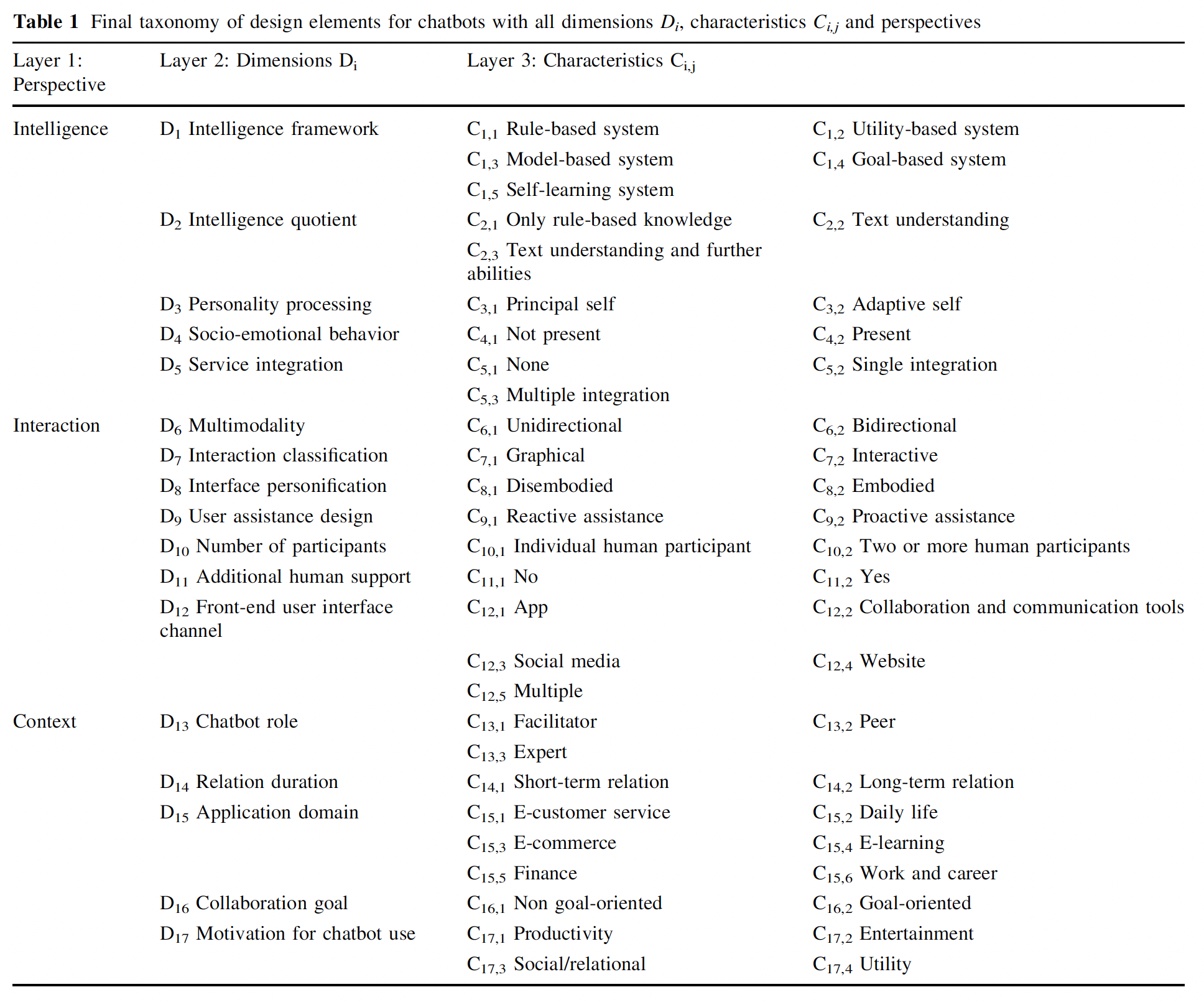
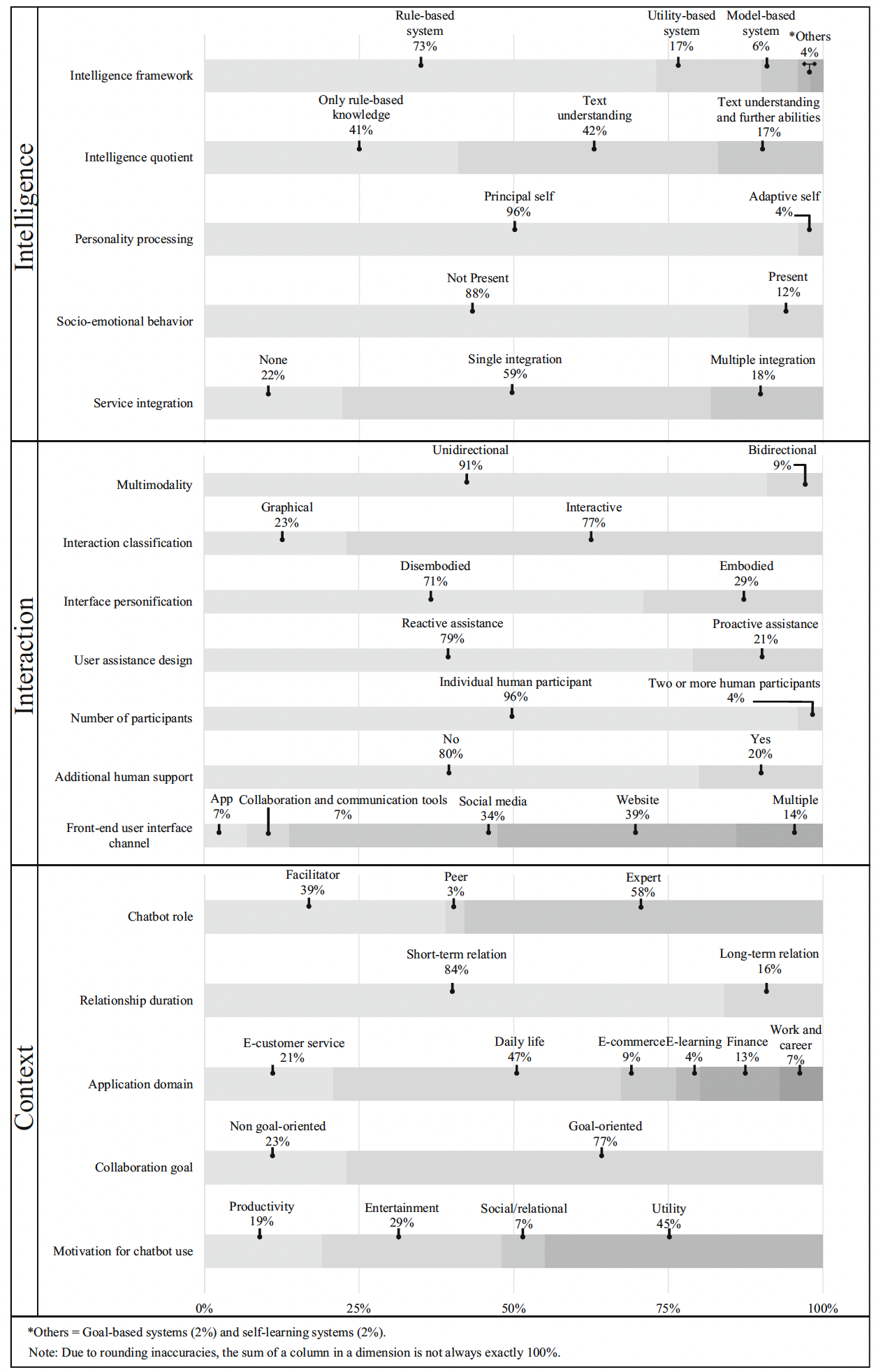
Table 2 shows the distributions of the characteristics in the five archetypes. We have named the five archetypes goal-oriented daily chatbot (A), non goal-oriented daily chatbot (B), utility facilitator chatbot (C), utility expert chatbot (D) and relationship-oriented chatbot (E) to represent the focus of each archetype. These five archetypes are intended to help developers to identify the relevant characteristics and derive fields of action based on their problem and area of application.
Lines of inquiry this paper opens 8
Research framings built by reading the notes related to this paper — the questions it feeds into.
What design features sustain romantic bonds with AI companion systems?- What temporal design dimensions characterize different chatbot relationship types?
- How do time gaps between conversations change what chatbots should remember?
- Does personalization help or hurt persistent companion chatbots?
- Does engagement with AI partners decay over time like chatbot relationships do?
- Can personalization delay or prevent novelty decay in chatbot relationships?
- How do chatbot design features like intimacy-by-design sustain romantic bonds?
- How does persistent versus temporary companion design affect relationship patterns?