The Digital Therapeutic Alliance and Human-Computer Interaction
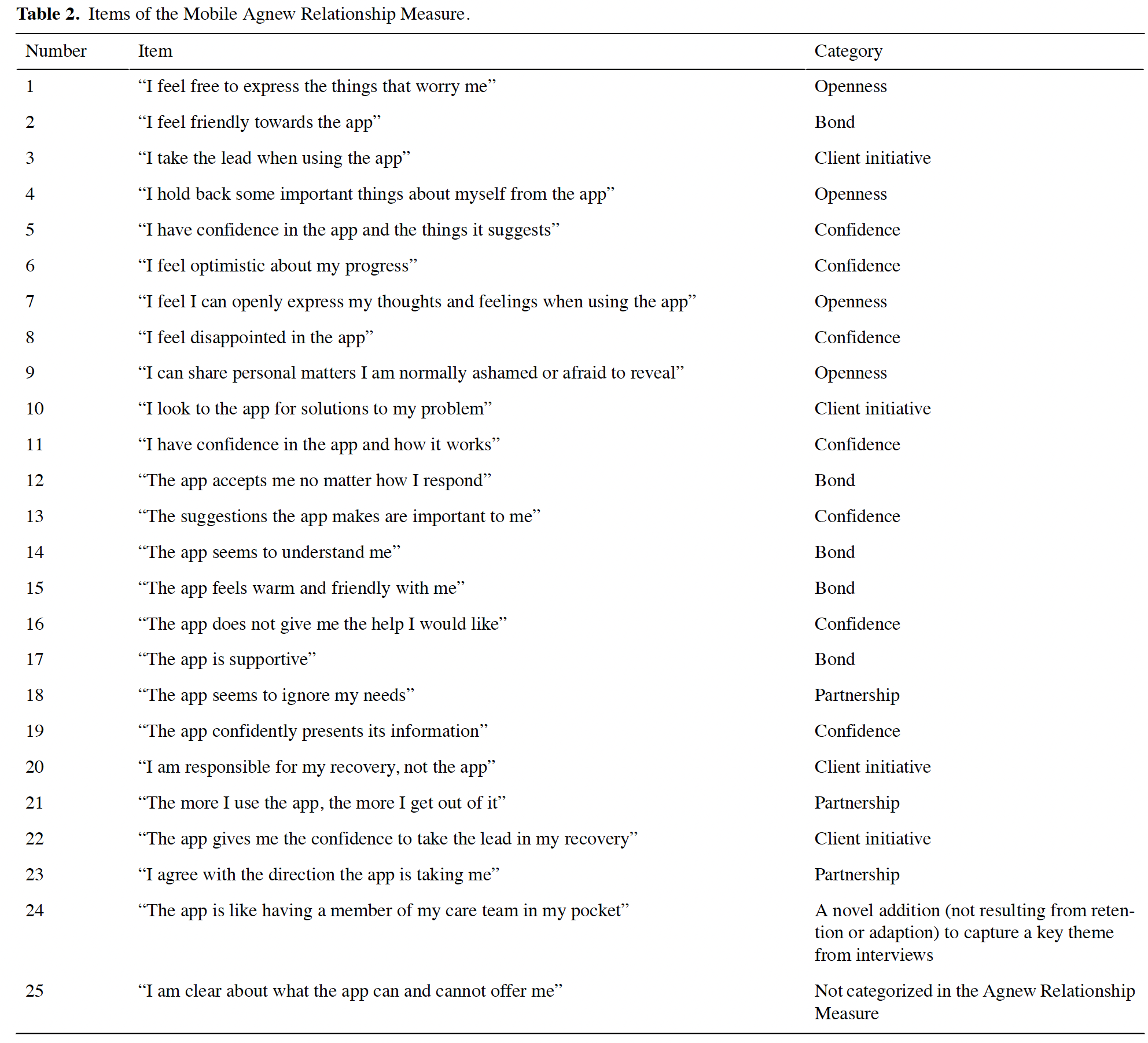
This conceptual paper explores one such instrument that has been proposed in the literature, the Mobile Agnew Relationship Measure, and examines it through a human-computer interaction (HCI) lens. Through this process, we show how theories from HCI can play a role in shaping or generating a more suitable, purpose-built measure of the digital therapeutic alliance (DTA), and we contribute suggestions on how HCI methods and knowledge can be used to foster the DTA in mental health apps.
The term digital therapeutic alliance (DTA) is a broad one that can be applied to a range of types of digital mental health care or interventions, including computer-mediated teletherapy [3,4], web/mobile apps, and therapy agents driven by artificial intelligence [5-8]. This paper focuses on the notion of a DTA in terms of web and particularly mobile apps for mental health, which predominate the work currently carried out under the banner of digital mental health. It is also where work in HCI can be most directly applied, particularly in the case of smartphone mental health apps. Research on smartphone interfaces and the psychological aspects of interaction between a user and their smartphone as a technological object could inform the development of mental health app features that are conducive to DTA formation.
In this paper, we use this Mobile Agnew Relationship Measure (mARM) as a specific starting point by discussing its items in terms of themes or topics in HCI. Despite the positive gains made with the mARM in terms of attempting to devise a custom measure of the DTA, this attempt is solely based on applying user feedback and considerations, obtained from a clinical psychology environment, to inform modifications to an existing measure from clinical psychology. Given the significance of the interaction between humans and machines in digital mental health interventions, we show that scrutinizing the mARM items through a lens of HCI theories can provide a valuable complementary approach to considering the DTA,
persuasive computing technology is “a computing system, device, or application intentionally designed to change a person’s attitudes or behaviour in a predetermined way” [26]. Fogg coined the term captology from the phrase Computers as Persuasive Technologies [26-28] to reflect this idea. As we will now briefly elucidate, persuasive design principles are relevant to several DTA criteria, not just the direct matter of whether the app feels persuasive. Informed by Fogg’s conceptualization of persuasive technology Oinas-Kukkonen and Harjumaa [29] have developed a concrete framework that transforms persuasive design principles into software requirements and system features. According to their persuasive systems design (PSD) model, there are 4 categories for persuasive system design, each consisting of several principles:
Primary task support: the design principles in this category support the execution of the user’s primary task and consist of reduction, tunneling, tailoring, personalization, self-monitoring, simulation, and rehearsal.
Dialogue support: the design principles in this category are about the feedback an interactive system provides to its users to help them move toward their goal or a target behavior. This category consists of praise, rewards, reminders, suggestion, similarity, liking, and social roles.
System credibility support: the design principles in this category describe how to design a system so that it is more credible and thus more persuasive. The category consists of trustworthiness, expertise, surface credibility, real-world feel, authority, third-party endorsements, and verifiability.
Social support: the design principles in this category describe how to design the system so that it motivates users by leveraging social influence. The category consists of social facilitation, social comparison, normative influence, social learning, cooperation, competition, and recognition.
There are several prominent accounts and frameworks based on this conception of well-being. The Self-Determination Theory (SDT) by Ryan and Deci [43,46] posits 3 basic elements that typically foster subjective as well as eudemonic well-being:
Autonomy: feeling agency and acting in accordance with one’s goals and values
Competence: feeling able and effective
Relatedness: feeling connected to others and a sense of belonging.
Similarly, the framework for eudemonic well-being by Ryff and Singer [47] is concerned with 6 core components: self-acceptance, autonomy, personal growth, positive relationships, environmental mastery, and purpose in life.
The positive psychology movement perhaps most conspicuously embodies the ethos of eudemonic or psychological well-being and the promotion of positive function and flourishing [48]. At the base of positive psychology is the PERMA model, which stands for positive emotions, engagement, relationships, meaning, and achievement. Positive psychology also identifies the importance of using “signature strengths every day to produce authentic happiness and abundant gratification” [49], strengths such as connectedness, gratitude, kindness, open-mindedness, perseverance, honesty, and courage [50].
The incorporation of this conception of well-being into the design and development of computing and information systems is embodied in the emerging field of positive computing, which addresses how technology can “support wellbeing that encompasses more than just immediate hedonic experience, but also its longer-term eudaimonia, or true flourishing” [51]. This is achieved through the integration of well-being theories and techniques from frameworks such as SDT and positive psychology into such technologies. For example, the autonomy component of SDT can be supported by offering options and choices over use and not in turn demanding actions from users without their assent [51]. The component of competence can be enhanced by including optimal challenges that are neither too difficult nor too easy, positive feedback, and opportunities for learning [51]. Finally, an aim to foster relatedness can determine approaches taken in the development of digital systems for social connection.
For example, direct communication such as wall posts, comments, and web chat is associated with greater relatedness over mere passive consumption of friends’ content [51]. Research [52] suggests that users develop a quality relationship or bond with health apps that are sensitive to their needs for autonomy and relatedness. Furthermore, listed below are the 5 identified dimensions of autonomy [53] “that are useful for understanding the mediating role that health and wellbeing apps have on the communication of information” [54]:
Degree of control and involvement that the user has within the app
Degree of personalization over the app’s functionality
Degree of truthfulness and reliability related to the information presented to the user and how this affects their decisions
User’s self-understanding of the goal pursuit and whether the app promotes or hinders a user’s awareness of their own agency
Whether the app promotes some form of moral deliberation or moral values in the actions it recommends.
The implementation of features conducive to the strengths of positive psychology is another example of positive computing. For example, designers might add a thanks button based on the evidence that expressing gratitude promotes overall well-being [55]. Furthermore, apps and software built from scratch to promote well-being, particularly digital mental health interventions, can be exemplars of positive computing. For example, the moderated online social therapy (MOST) mental health platform has been built on a basis significantly influenced by positive psychology [56]. Previous work on MOST suggests that platform design informed by the principles of SDT supports the emergence of a DTA between users of a digital mental health platform and the platform itself [57].
Lines of inquiry this paper opens 24
Research framings built by reading the notes related to this paper — the questions it feeds into.
How can we detect and account for LLM involvement in academic writing?- Why do some LLM clusters cite broader psychology than others?
- Do LLM adopters actually cite more diverse and younger research?
- Do LLMs show stigma or reinforce delusions in mental health contexts?
- Why do Llama-based models outperform GPT-4 in objective clinical guidance?
- Can large language models actually deliver cognitive behavioral therapy techniques?
- Can embodied agents overcome the LLM skill gap in therapy outcomes?
- Why do therapists and patients report misaligned perceptions of the working relationship?
- What other therapy constructs could be measured from transcripts using this approach?
- How does automated transcript analysis compare to patient self-report on engagement?
- Can real-time therapist feedback improve outcomes using computational alliance measurement?
- How does turn-level working alliance inference enable real-time therapist feedback?
- How do bond scores predict actual therapy outcomes in digital interventions?
- Can real-time pronoun feedback improve therapist training outcomes?
- Can synchrony metrics automatically evaluate the quality of therapeutic AI conversations?
- What metrics measure whether emotional support conversations actually reduce user distress?
- Can AI feedback help struggling counselors improve their therapeutic relationships?
- Does text-only interaction make measuring therapeutic alliance more difficult?