See you soon again, chatbot? A design taxonomy to characterize user-chatbot relationships with different time horizons
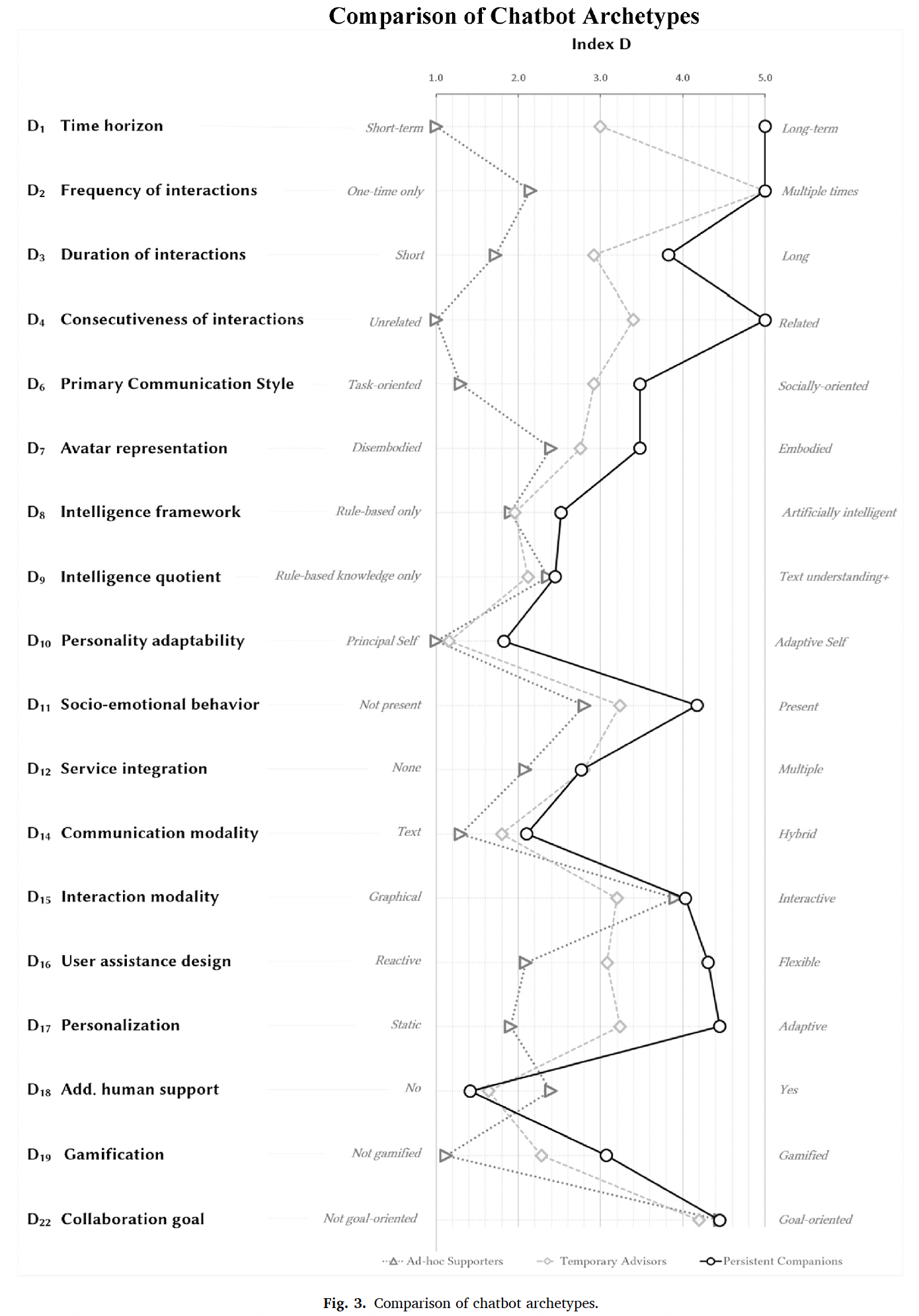
Users interact with chatbots for various purposes and motivations – and for different periods of time. However, since chatbots are considered social actors and given that time is an essential component of social interactions, the question arises as to how chatbots need to be designed depending on whether they aim to help individuals achieve short-, medium- or long-term goals. Following a taxonomy development approach, we compile 22 empirically and conceptually grounded design dimensions contingent on chatbots’ temporal profiles. Based upon the classification and analysis of 120 chatbots therein, we abstract three time-dependent chatbot design archetypes: Ad-hoc Supporters, Temporary Assistants, and Persistent Companions. While the taxonomy serves as a blueprint for chatbot researchers and designers developing and evaluating chatbots in general, our archetypes also offer practitioners and academics alike a shared understanding and naming convention to study and design chatbots with different temporal profiles.
despite diverse chatbot characteristics that have previously been investigated with regards to consequential design implications, for example, whether chatbots serve general or domain-specific purposes (Gnewuch, Morana, & Maedche, 2017) or whether chatbots are intended to engage in dyadic one-to-one or in multiparty interactions (Seering, Luria, Kaufman, & Hammer, 2019), there is a scarcity of empirical research on design differences contingent on chatbots’ temporal profiles.
If chatbots are used for one-time-only conversations, users will likely seek to get something done quickly via the chatbot, which makes the chatbot a mere “communication medium” (Zhao, 2006, p. 402). In contrast, if chatbots are used to achieve a specific personal long-term goal, users will rather be committed to undergo longer personal learning or development processes together with the chatbots which emphasizes the notion of chatbots as “social actors” (Reeves & Nass, 1996).
A robot’s temporal profile can be characterized by the following time-dependent dimensions: the time horizon as the total period during which the user engages with a robot, the duration of (individual) interaction(s), and the frequency in the case of multiple interactions (Baraka et al., 2020). The fourth dimension in human-robot interaction research concerns synchronicity which describes whether a (remotely controlled) robot responds immediately (synchronously) or delayed (asynchronously) when it is located in a more distant place.
this work’s objective is thus twofold: First, to identify all design elements contingent on the temporal dimension of user-chatbot relationships and to develop a comprehensive design taxonomy that allows us to characterize user-chatbot relationships with different time horizons (RQ1), and, second, to quantitatively assess differences between chatbots for either short-, medium-, or longterm purposes and to illustrate typical design configurations by identifying three chatbot archetypes (RQ2).
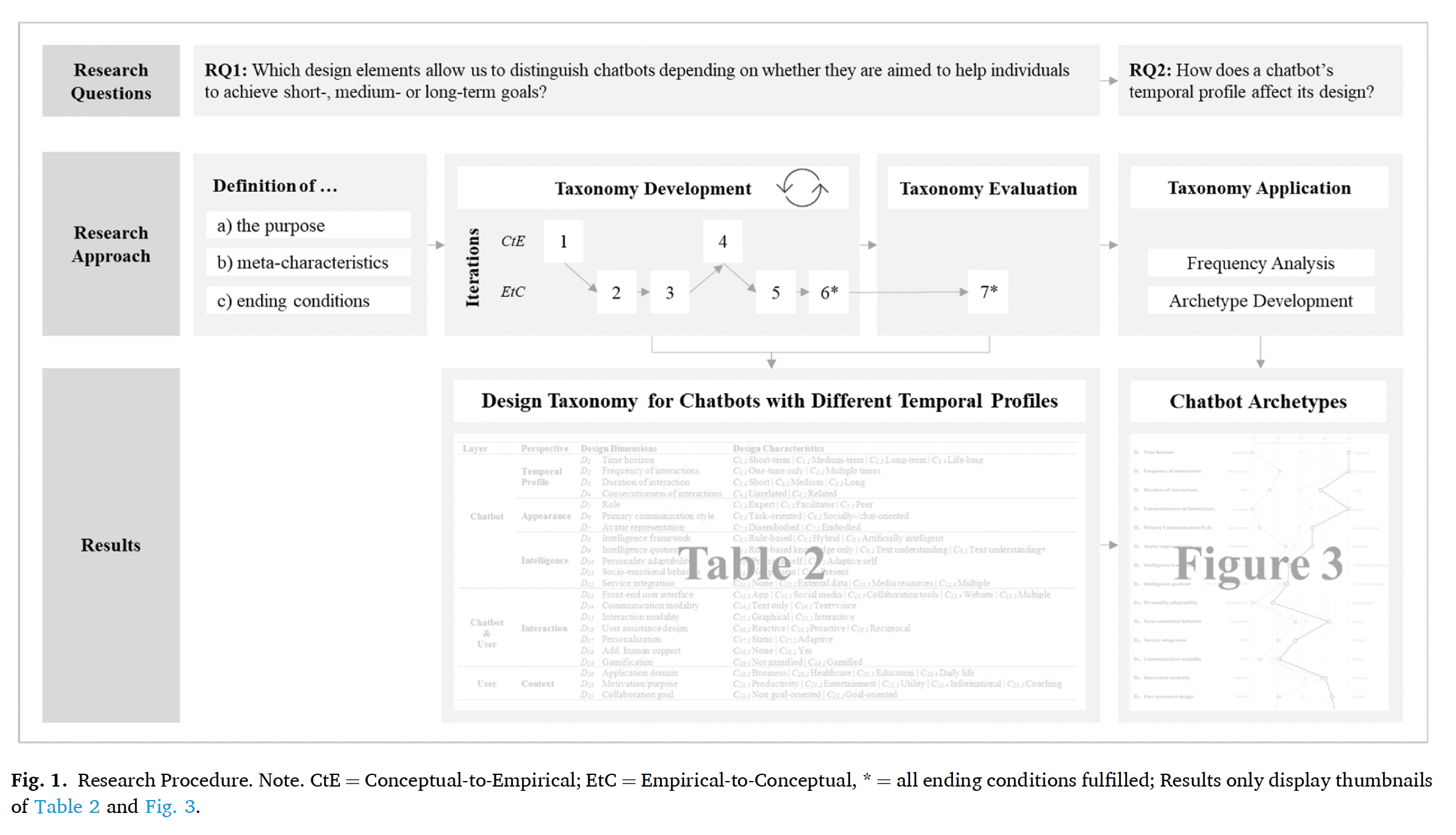
The publication of a “Taxonomy of Design Elements for Domain-specific Chatbots” by Janssen, Passlick, et al. (2020) on April 6, 2020, allowed us to challenge and further refine our taxonomy in another conceptual-to-empirical iteration. Therefore, we compared both taxonomic structures, all design dimensions, and design characteristics hitherto and identified that we had eleven dimensions in common that were identical or very similar in meaning, four dimensions that had not been included in the aforementioned taxonomy, and five which we had not listed in ours yet.
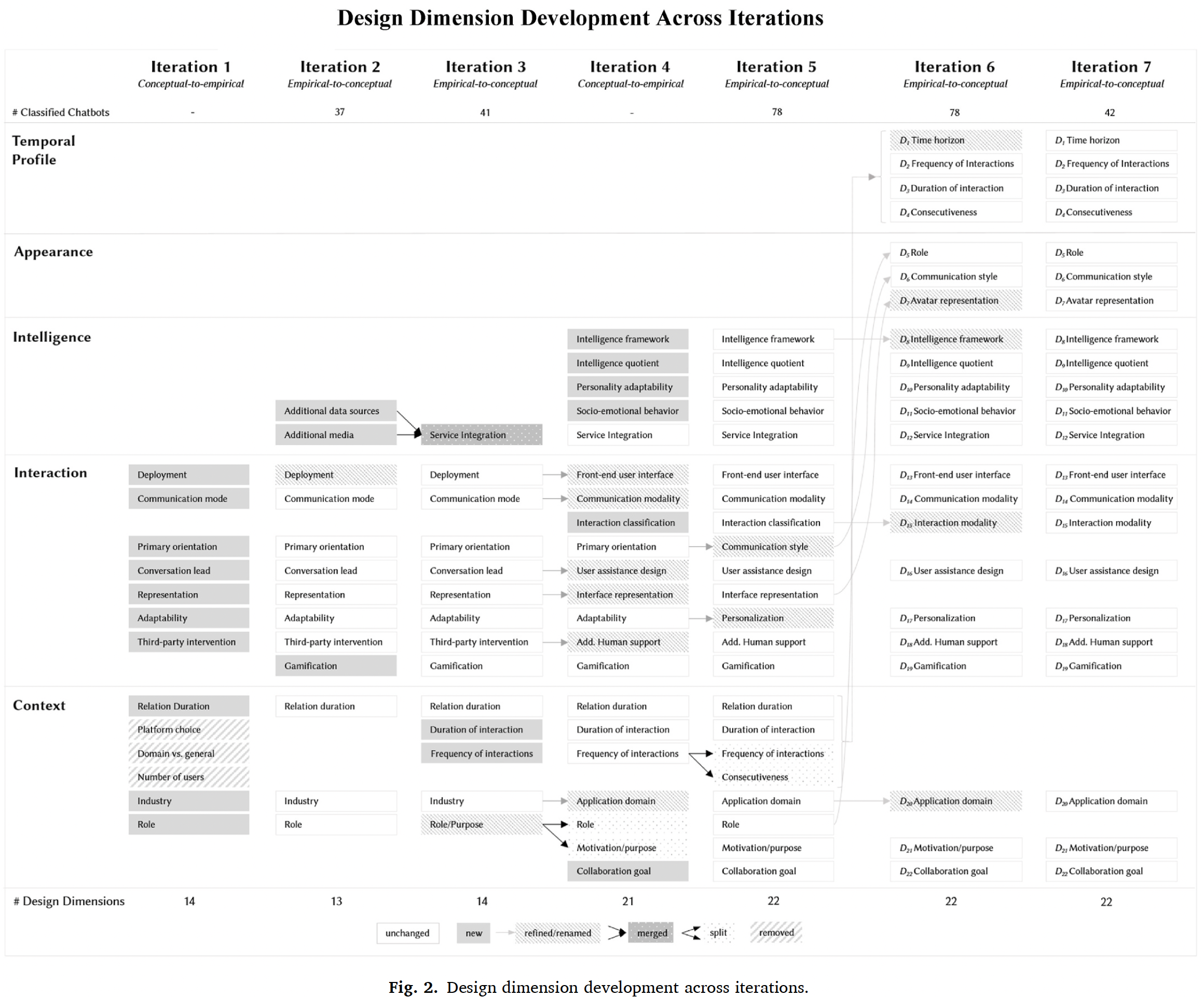
Eventually, only 42 chatbots were still accessible. All other chatbots were either no longer detectable on the websites
4.1.1. Temporal profile
The first overarching perspective, a chatbot’s temporal profile, can be characterized by the D1 time horizon of the user-chatbot relationship, the D2 duration of (individual) interactions, the D3 frequency, and the D4 consecutiveness of interactions with the user. The D1 time horizon of a user-chatbot relationship can be either C1,1 short-, C1,2 medium-, C1,3 long-term, or C1,4 life-long (Baraka et al., 2020). Short-term relationships are characterized by only a single or few occasional interactions (e.g., self-diagnosis healthcare chatbots like BABYLON or GYANT). Medium- and long-term relationships always consist of multiple interactions over a certain period (Baraka et al., 2020, p. 29). A typical example for a medium-term chatbot is an educational chatbot that teaches a particular course’s defined junk of content (e.g., CODEMONKEY or BOOKBUDDY) over a defined period (e.g., one school semester).
Lines of inquiry this paper opens 24
Research framings built by reading the notes related to this paper — the questions it feeds into.
What design features sustain romantic bonds with AI companion systems?- What temporal design dimensions characterize different chatbot relationship types?
- How do time gaps between conversations change what chatbots should remember?
- Does personalization help or hurt persistent companion chatbots?
- Does engagement with AI partners decay over time like chatbot relationships do?
- Can personalization delay or prevent novelty decay in chatbot relationships?
- How do chatbot design features like intimacy-by-design sustain romantic bonds?
- How does persistent versus temporary companion design affect relationship patterns?
- How do user expectations change as chatbots remember more interactions?
- How does the expectation ratchet affect long-term chatbot satisfaction?
- Why do persistent chatbot companions face novelty decay that ad-hoc supporters avoid?
- Do model updates disrupt established sources of support for regular chatbot users?
- How does consciousness attribution drive emotional dependence on chatbots?
- How does emotional dependence on chatbots affect user wellbeing?
- How do dropout rates and low adherence affect chatbot therapy outcomes?