Improving Conversational Recommender Systems via Transformer-based Sequential Modelling
In Conversational Recommender Systems (CRSs), conversations usually involve a set of related items and entities e.g., attributes of items. These items and entities are mentioned in order following the development of a dialogue. In other words, potential sequential dependencies exist in conversations. However, most of the existing CRSs neglect these potential sequential dependencies. In this paper, we propose a Transformer-based sequential conversational recommendation method, named TSCR, which models the sequential dependencies in the conversations to improve CRS. We represent conversations by items and entities, and construct user sequences to discover user preferences by considering both mentioned items and entities.
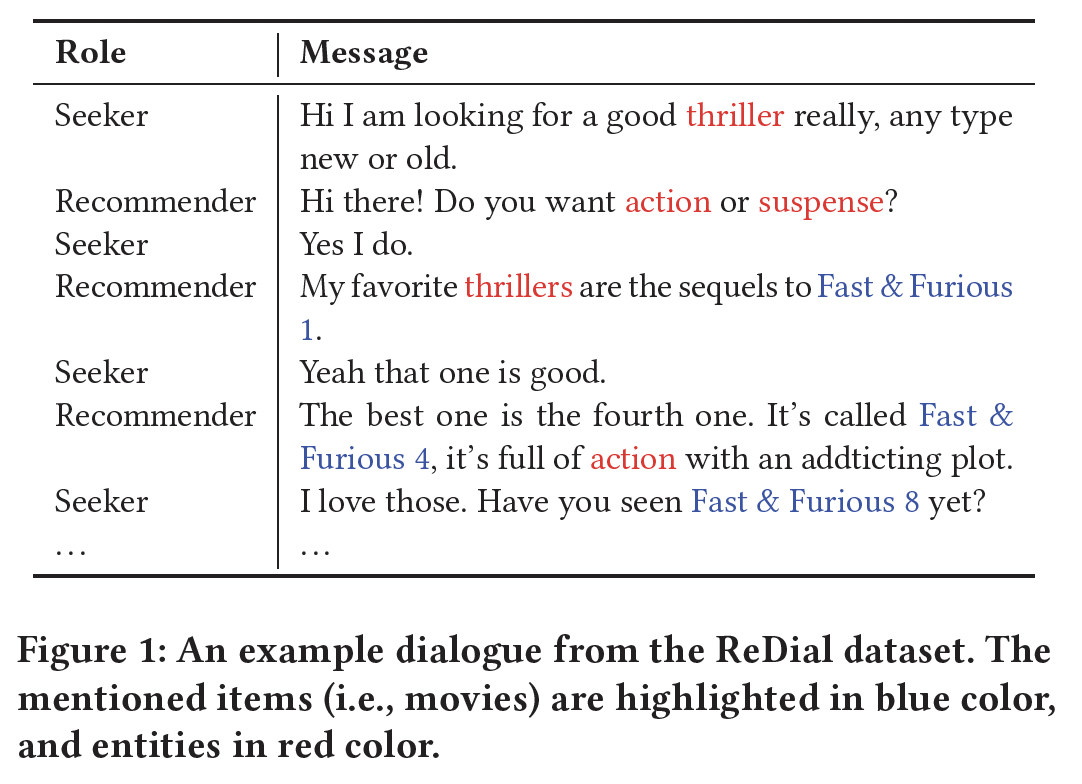
it is common to mention entities that are closely related to the items to be recommended, e.g., director and genre of a movie in our example. Second, the mentioned items (and also entities) naturally form a sequence, following the development of the conversation. That is, there is an order impact among items in a conversation and potential sequential dependencies within the conversation. For instance, when people talk about a movie (e.g., Fast & Furious 1), it is natural and reasonable to recommend a sequel or prequel of that movie (e.g., Fast & Furious 4). We argue that the modeling of such sequential dependency can well capture the context
As a rapidly growing research topic in recent years, a number of solutions for CRS have been proposed [5, 12, 13, 32]. One attempt is based on the “system asks – user responds” mode and simulates conversations by using some “anchor” text, e.g., item aspects [26], entities [31–35], facets or attributes [7, 8, 17, 29]. They usually utilize a belief tracker to infer the anchor-based preferences to improve CRS. Another mainstream approach is based on human-generated dialogues [1, 2, 10, 11, 14, 20, 21, 24, 25, 28, 30]. For instance, at the early stage, Li et al. [9] proposed a CRS dataset, ReDial, and presented a benchmark model for item recommendation. ReDial soon became the most widely used dataset for CRS. Given that entities within ReDial utterances are linked to a knowledge base, most subsequent work uses knowledge graphs to improve CRS [2, 11, 14, 27, 28, 30]. Although the aforementioned work demonstrates success to some extent, they neglect the order impact among items or entities discussed earlier. Hence, these existing solutions do not model the potential sequential dependency within the conversations.
Lines of inquiry this paper opens 24
Research framings built by reading the notes related to this paper — the questions it feeds into.
How should recommendation systems balance individual preference and diversity?- Why do bag-of-mentions models discard conversation order in the first place?
- What dialogue patterns do real human recommendation conversations actually contain?
- What other conversation structures besides mention order carry predictive information for recommendation?
- Why did conversational recommenders drop both item and user similarity signals?
- Does transforming critiques into preferences change how conversational recommenders should decide when to ask versus recommend?
- How much of conversational recommender progress comes from chasing flawed metrics?
- What would conversational recommender evaluation look like if ground truth was carefully curated?
- Should recommenders discard old user data uniformly or selectively retain historical signals?
- Can mention sequences exploit shortcuts like repeated items rather than learning genuine preferences?
- What role does conversation state tracking play in timing ask versus recommend?
- Do look-alike users help more when the current session is sparse or vague?
- Does sequential structure within sessions complement cross-session preference channels?
- What interaction history signals indicate what a participant finds relevant?
- How should dialogue state tracking change when user preferences shift mid-conversation?
- How does sequence organization differ between spoken conversation and text chat?