Expanding Explainability: Towards Social Transparency in AI systems
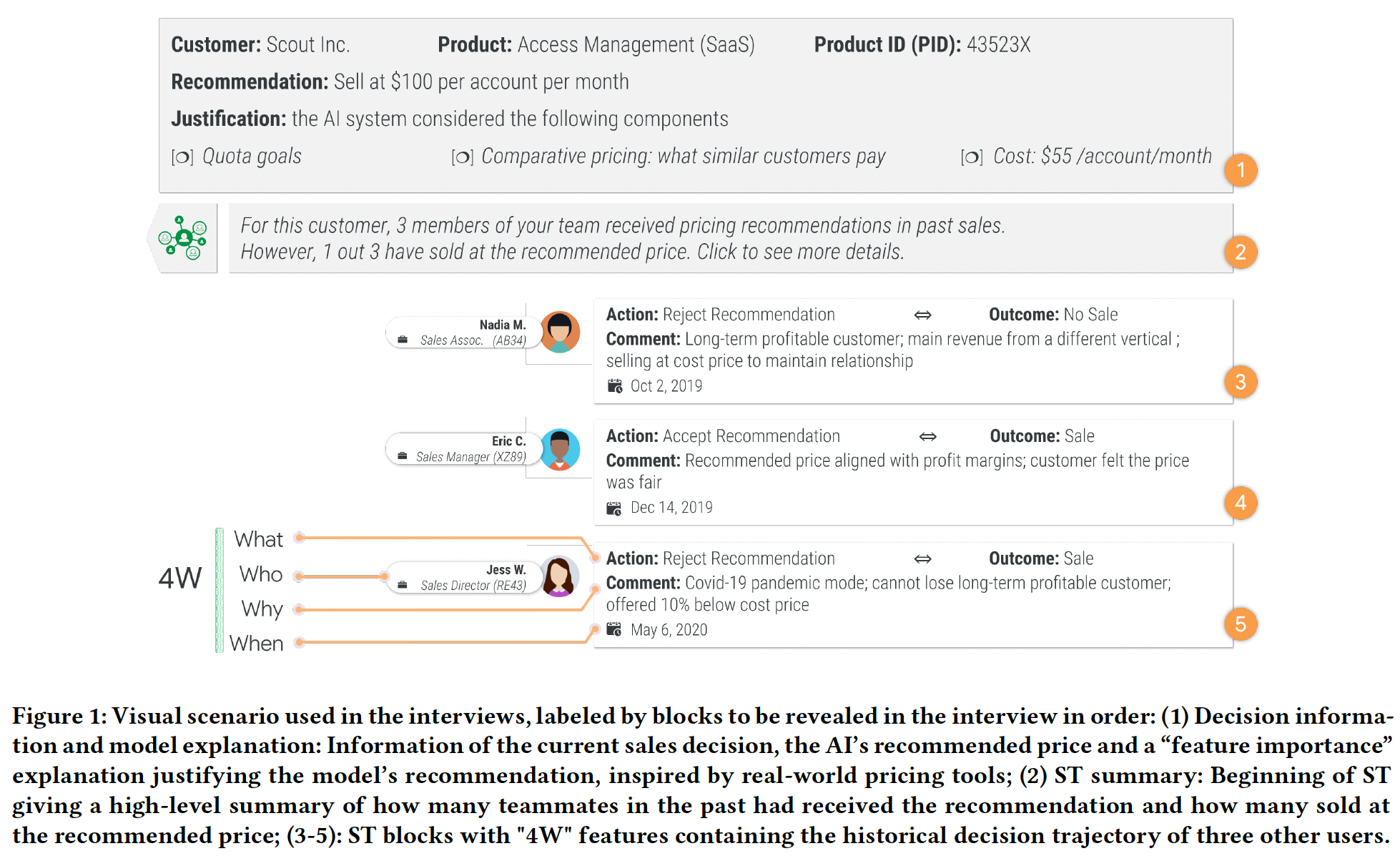
As AI-powered systems increasingly mediate consequential decision-making, their explainability is critical for end-users to take informed and accountable actions. Explanations in humanhuman interactions are socially-situated. AI systems are often socioorganizationally embedded. However, Explainable AI (XAI) ap proaches have been predominantly algorithm-centered. We take a developmental step towards socially-situated XAI by introducing and exploring Social Transparency (ST), a sociotechnically informed perspective that incorporates the socio-organizational context into explaining AI-mediated decision-making. To explore ST conceptu ally, we conducted interviews with 29 AI users and practitioners grounded in a speculative design scenario. We suggested constitu tive design elements of ST and developed a conceptual framework to unpack ST’s efect and implications at the technical, decisionmaking, and organizational level. The framework showcases how ST can potentially calibrate trust in AI, improve decision-making, facilitate organizational collective actions, and cultivate holistic explainability. Our work contributes to the discourse of Human- Centered XAI by expanding the design space of XAI.
Introduction. Explanations matter. In human-human interactions, they provide necessary delineations of reasoning and justifcation for one’s thoughts and actions, and a primary vehicle to transfer knowl edge from one person to another [65]. Explanations play a central role in sense-making, decision-making, coordination, and many other aspects of our personal and social lives [41]. They are becom ing increasingly important in human-AI interactions as well. As AI systems are rapidly being employed in high stakes decision-making scenarios in industries such as healthcare [63], fnance [76], college admissions [79], hiring [19], and criminal justice [37], the need for explainability becomes paramount. Explainability is not only sought by users and other stakeholders to understand and develop appropriate trust of AI systems, but also to support discovery of new knowledge and make informed decisions [58].
Discussion / Conclusion. Situating XAI through the lens of a Critical Technical Practice, this work is our attempt to challenge algorithm-centered approaches and the dominant narrative in the feld of XAI. Explainability of AI systems inevitably sits at the intersection of technologies and people, both of which are socially-situated. Therefore, an epistemic blind spot in that neglects the “socio" half of sociotechnical sys tems would likely render technological solutions inefective and potentially harmful. This is particularly problematic as AI technolo gies enter diferent socio-organizational contexts for consequential decision-making tasks. Our work is both conceptual and practical. Conceptually, we address the epistemic blind spot by introduc ing and exploring Social Transparency (ST)–the incorporation of socio-organizational context–to enable holistic explainability of AI-mediated decision-making. Practically, we progressively develop the concept and design space of ST through design and empirical research.
Lines of inquiry this paper opens 24
Research framings built by reading the notes related to this paper — the questions it feeds into.
How do users confuse explanation quality with actual system accuracy?- Why do users interpret AI outputs through frameworks meant for human experts?
- Why does polished explanation make wrong AI systems more persuasive than poorly explained ones?
- What explanation format actually helps users detect errors in AI systems?
- Should explanation quality be measured by user satisfaction or behavior prediction?
- How can humans evaluate explanations from systems they did not train?
- How should AI explanations be evaluated as human interfaces rather than model properties?
- What makes a scientist satisfied with an explanation versus just a prediction?
- Do people who choose to use AI fact-checkers actually become better at spotting misinformation?
- Can organized response format trick users into overestimating AI reliability?
- Can explainability and appropriate trust work against each other?
- Are users overconfident in AI advice even when it actually improves accuracy?
- Why don't users push back when AI makes obvious mistakes about false claims?
- Can external process logs make AI errors verifiable and harder to hide?